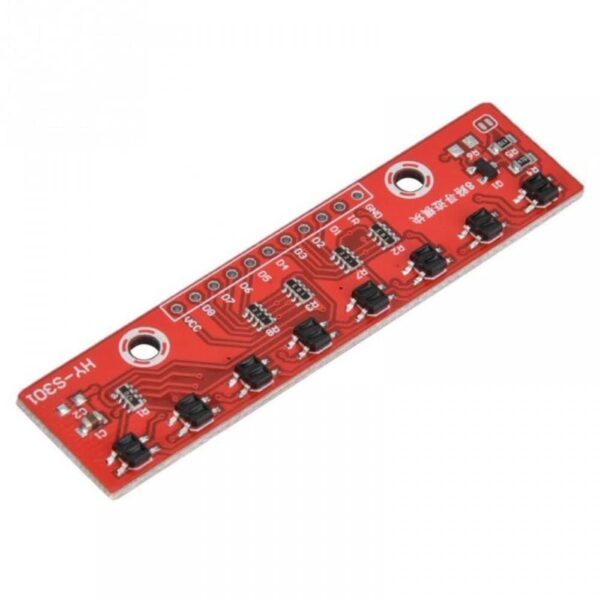
🔍 QTR-8RC Reflectance Sensor Array – 8-Channel IR Line Sensor (RC Version)
The QTR-8RC is a high-performance reflectance sensor array designed to detect contrast between surfaces, such as black lines on white backgrounds. Ideal for line-following robots, edge detection, or maze-solving applications, this sensor array uses infrared LEDs and phototransistors arranged in a straight line for precise, fast, and flexible tracking.
✅ Key Features:
-
8 Individual Sensors – Each with its own IR emitter and phototransistor pair.
-
Digital Output (RC Decay Time) – Measures reflectance via charge/discharge timing (RC time).
-
High-Speed Detection – Works well even at high robot speeds.
-
Adjustable Brightness – Through included resistor or PWM control.
-
Compact Form Factor – Can be split into smaller units (e.g., 2× QTR-4RC or custom-sized arrays).
-
Works with 3.3V or 5V logic – Ideal for Arduino, ESP32, STM32, Raspberry Pi, etc.
📦 Technical Specifications:
| Parameter | Value |
|---|---|
| Number of Sensors | 8 |
| Operating Voltage | 5 V (recommended), 3.3V compatible |
| Output Type | Digital (RC timing) |
| Output Format | Reflectance measured via time delay |
| Typical Sensing Range | ~3 mm (depends on surface) |
| IR LED Wavelength | ~940 nm |
| Array Width | ~75 mm |
| Pin Header Type | 2.54 mm standard (included) |
🧠 How It Works:
The QTR-8RC doesn’t output analog voltages. Instead, each output pin behaves like a capacitor discharge timer:
-
Charge the sensor line (set high).
-
Switch to input and measure how long it takes to go LOW.
-
Faster discharge = more reflectance (white surface), slower = less (black line).
Perfect for timing-sensitive microcontrollers like Arduino or STM32 that can measure pulse durations accurately.
🎯 Applications:
-
Line-following robots
-
Maze solvers
-
Edge detection
-
Surface tracking
-
PID-based autonomous navigation